
Internal communication is the foundation of employer branding
Published

During Business Fest we spoke with several colleagues working in the fields of HR and employer branding. We came to the conclusion that although they all see the need to establish more effective internal communication, it means something a little different to each of them. That is exactly why in this article I want to highlight why effective internal communication is essential from the point of view of the employer image, and what effective internal corporate dialogue means for CHEQ.
There is no employer branding without internal communication
According to research, 75% of jobseekers apply to a company that actively deals with employer branding. However, as much as we would like to believe that
- during employer branding you only have to focus on the world outside the company
- what counts is what we show and communicate outwards to jobseekers and candidates,
we have to admit that this is not the case.
To create and maintain a truly good employer image, effective dialogue between employees and management is essential, regardless of which stage of the employee life cycle we are in. From the very first moment of the selection process, through onboarding, during the time of employment and at exit too, we have to ensure the chance of direct, open and effective communication. This way we can turn the acquaintance formed with the employer into a pleasant experience. And ultimately this is what determines how attractive a workplace is, how its current and former employees speak about it.
That is also why attention has to be paid to
- important company news reaching employees who are on the payroll in time,
- involving colleagues in the life of the company,
- making it easier for them to achieve results,
- giving them the opportunity to ask questions and share suggestions,
- asking them for feedback, which we also take into account
All of this can be supported by establishing effective internal corporate communication. And what does this mean to us?

Effective internal corporate communication according to CHEQ
Effective conversation within the organisation is:
- Structured
- Clear
- Two-way
- Secure
- Current/Modern
- Accessible
- Simple
- Measurable
Let us see what all this means more precisely.
1. Structured
One of the tasks of internal communication is to inform employees. This, however, does not end merely with sending out company announcements. It is also extremely important that the documents needed for work become easily accessible for every employee, thereby saving the time spent on lengthy searching.
According to a survey by Elastic, 60% of those working remotely, that is, not in the office, stated that they waste more time searching for documents than writing emails. What is more, 85% of workers spend time on a daily basis searching for documents and information. According to a McKinsey survey, this means that 20-25% of working time is spent searching for the information that is indispensable to completing tasks or satisfying personal workplace information needs.
We designed the CHEQ internal communication app specifically so that employees can access the important knowledge that concerns everyone in an instant.
We place these logically under well-structured menu items, which we define together with our clients. This makes it possible for employees to access the documents they need within seconds, documents whose data is current, authentic and reliable.
This way time and energy can be saved for colleagues. In addition, frustration also decreases, since the information they are looking for is immediately available to them. They can make progress with their tasks in a better mood and with more momentum. And as a result they also make better decisions.
2. Clear
Like CHEQ, a managed internal communication channel is much clearer than channels that provide internal information flow based on the model of a social network. This is possible because it is assigned along predefined conditions who can initiate a conversation with whom. HR and/or senior leaders can send a message to anyone, middle managers can also send messages to their own team or to senior management, and employees can likewise initiate a discourse with management.
In other words, it simply cannot happen that, similar to the news feeds well known from social media, a tsunami of messages suddenly breaks over us. So without any searching, at a single glance the employee can identify the information that concerns them and is important for them (too). This is, on top of that, supported by the menu structure.

3. Two-way
A basic requirement of effective internal corporate communication is that it be two-way. That is, that genuine dialogue develops between the employer and the employees. If employees cannot react to and cannot initiate communication with management, then we are talking about one-way informing. This is not conversation, but simply notification, which in terms of its effect falls far short of the effectiveness of dialogue.
That is exactly why we designed CHEQ so that it supports dialogue within the organisation. So, alongside management immediately and directly reaching employees with its messages, they too have the opportunity to initiate communication.
So not only can they be informed in time and accurately about the company's most important news and events, but they can also easily indicate if they
- have fallen ill,
- need new work clothes/equipment,
- have seen or experienced an error/danger in the work area,
- can make anonymous reports,
- can express their opinion,
- can rate, vote, comment,
- can raise topics interesting to them, and so on
What is more, whoever initiates the conversation, a reply/reaction arrives to it. This way dialogue is genuinely created between management and the employee.
4. Secure
It is a legal requirement for companies to make it possible for their employees to make anonymous reports. However, an employee needs to feel that they can safely and boldly share a piece of information in their possession not only when they want to report improper (perhaps unlawful) behaviour. They also need to feel this if they merely have to submit their opinion during a pulse survey, or if they request an employment certificate.
That is exactly why it is extremely important that employees' answers, or the dialogue initiated by them, are invisible to the other colleagues. If colleagues have no view of and access to every discourse, then the "joking" trolls cannot appear either, and moderating the conversations is not necessary.
Of course, this does not rule out management easily and quickly sharing the aggregated result and conclusions of a particular survey, and the subsequent actions, with the members of the organisation. In fact, this is expressly recommended! By doing so, management signals that employees' opinion matters, that it heard them and that it incorporates this information into its decisions. This is how a sense of being valued can be built and engagement strengthened in employees, which also has a positive effect on the employer brand.
5. Current/Modern
According to HR professionals and leaders, despite digitalisation, numerous large companies still communicate with their employees, especially blue-collar workers, using posters put up on notice boards, flyers and printed forms. The effectiveness of these is, unfortunately, impossible to measure. There is no knowing how many colleagues read the posted messages and when. It may even happen that they learned about certain opportunities too late and, because of this, missed out on events, lost out on fringe benefits, and so on.
The situation is not much better in the case of those working in an office environment either. Here email exchange does come into question, but this cannot be considered a particularly effective solution either. The response and reaction time takes extremely long, if the letter is opened at all and not left to get lost in the flood of messages. What is more, this is not really dialogue between the organisation and the employee either, but rather a one-way "declaration" of information without taking colleagues' needs into account.
These pseudo internal communication methods are all now considered outdated. We live in a world where, according to research, nearly 64.5% of the Hungarian population owns a smartphone and about 6 million people go online on their mobile. In other words, it seems like an obvious solution to establish a communication channel that also works on a smartphone. One that is far more effective and cost-effective than mass SMS sending or making phone calls would be. CHEQ is precisely this kind of communication solution!
6. Accessible
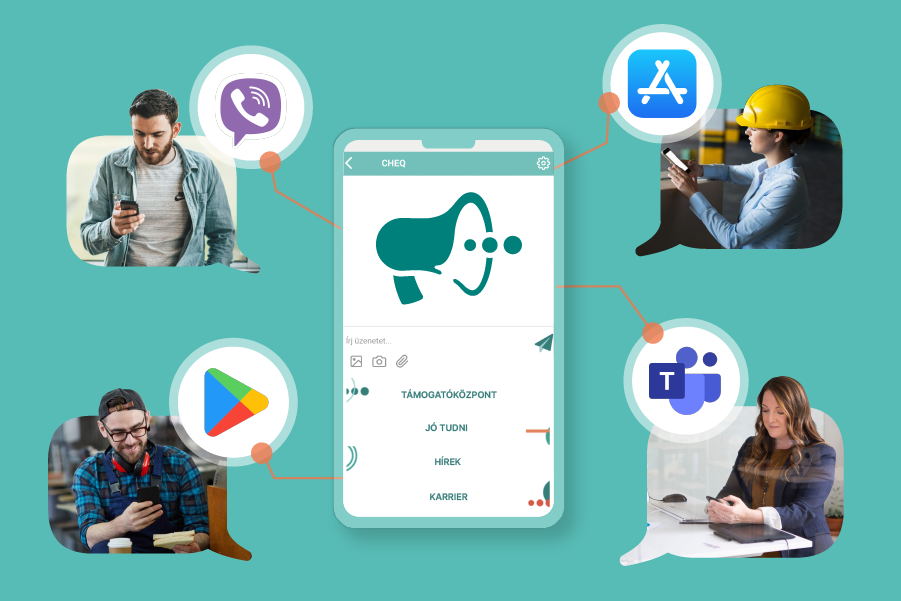
An effective internal communication tool reaches employees through a channel they can access easily. CHEQ is available through Viber or your company’s native app on personal and company smartphones, so corporate messages also reach colleagues who work away from a desk.
Whichever solution they choose, they are always immediately informed about the most important news, can take part in the life of the company, and can initiate handling their administrative matters at any time (e.g. requesting an employment certificate, updating data, etc.). And all of this does not involve any particular financial or energy investment on the company's part. In fact, the costs associated with introducing it can pay off in as little as 3-6 months!
7. Simple
A huge advantage of an excellent internal communication channel is that its use is simple and convenient and does not mean extra work for HR, for the person dealing with employer branding, or for management. It makes it possible to
- prepare notifications and messages that we send out on a schedule.
- translate our messages at the touch of a button and thereby notify our foreign colleagues too, even without involving interpreters
- connect with other software so that we do not have to do the same task twice (e.g. sending payslips in encrypted form, digital signature, updating the user database, sending an email message, gamification, etc.)
What is more, if it is supported by artificial intelligence (e.g. ChatGPT is available within CHEQ), then even writing the messages becomes a matter of moments. This way using the channel for internal dialogue can be really convenient.
At the same time, one should not forget that using the communication channel also has to be simple and convenient for the end users, that is, for colleagues. After all, this is what ensures that they actually use it.
8. Measurable
From the point of view of effectiveness, it is essential that internal communication be measurable. Management can use the measurement results as KPIs for the continuous improvement of leadership/internal communication, and through them you can optimise
- information flow - you convey the message in the form in which most of your colleagues like to consume it (text, image, video, audio, etc.), because this way they genuinely process the content and do not just quickly open your message
- the workflow - alongside important company announcements and company events, you share messages, documents, microlearning materials and so on that employees need and are happy to use, so you spend your valuable time on what genuinely matters
- your costs - you can precisely determine which communication platform or model is worth maintaining and which is not, in order to maximise your effective communication
- employee engagement and involvement - if you know what moves your colleagues, then you also know how you can involve them better in the life of the company, so that they become more committed and enthusiastic team members in the long run, thereby also increasing the company's performance and reducing turnover
If you too need an internal communication application that meets all of the points mentioned above, then get in touch with us and let's talk about the details!