
Improving internal communication can be achieved with these 7 tips
Published

Many people think that if we can speak and hear, if we can write and read, then we can already communicate. As sad as it is, this is not the case! Effective communication requires more than this. That is exactly why it is no wonder that improving internal communication is a challenge for numerous companies.
In this article we give you 7 tips on how you can improve your company's internal communication.
What is (internal) communication anyway?
First of all, let us clarify what communication actually is. This is necessary so that we can clearly see why it is not as simple as we might think at first.
You may still remember the communication model learned at school, which looked similar to the figure below.
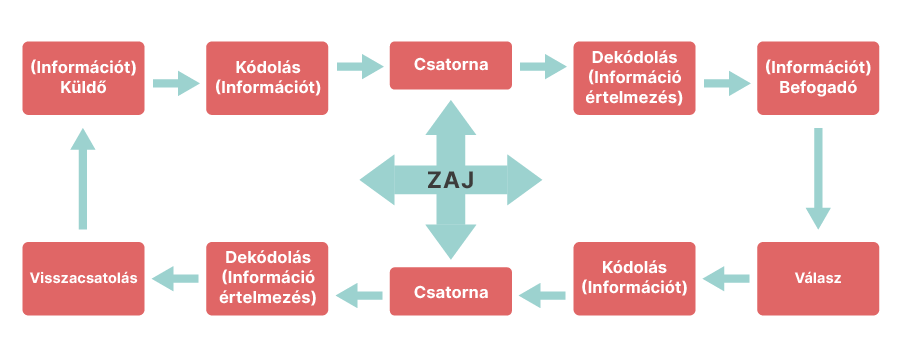
As you can see, communication is an act involving at least two participants. In the case of companies, however, it often involves multiple participants. Usually one person sends the message/information on behalf of the company. They fill the role of the sender in the model, who tries to communicate something towards one or more employees (recipient(s)). They provide the two endpoints of the communication, but alongside them there is a further factor present in the model.
Factors that influence the success of communication:
- encoding - how the sender/originator formulates the message
- the channel - by what means they share the information (e.g. circular, chat, notice board, public address system, etc.)
- decoding - if the information reaches the addressee (recipient), what do they understand from it? How do they interpret it?
- noise - what disturbing factors have to be overcome and filtered out for the information to be 100% receivable (e.g. if you sent a circular, other emails can constitute communication noise)
- the reply/reaction - the recipient must in every case send a reply to the sender, thereby demonstrating that they received, processed and understood the information (in this case it also becomes clear if they happened to misinterpret the message)
- feedback - the recipient's confirmation that they received the message has arrived back to the sender
If any of these factors is missing or working poorly, then we can speak of a communication problem. And according to experience, this is the situation at most companies. This is perhaps not even that surprising once we know that according to a survey by Arthur J. Gallagher & Co., 60% of companies do not have a long-term internal communication strategy. What is more, even among those who do have one, 12% do not measure the effectiveness of their communication.
The language used in internal communication
In today's globalised world we often have to work together with colleagues of different languages and cultures. This makes effective communication even harder, since often even two people speaking one language talk past each other. How much more true this is if one of them, or both of them, use a foreign language in the communication!
In a multinational office environment we might say it is a fair expectation that every colleague speaks at least conversational-level English or German. Depending on what kind of company it is. However, the same cannot be expected of blue-collar colleagues!
Moreover, it must also be taken into account that these days it is not rare for factories to have Burmese, Korean, Vietnamese and other workers alongside the Hungarian employees. So now it is not only a challenge for the vision of the foreign-managed company to be communicated accurately to the Hungarian blue-collar employees, but for every colleague of a different language to understand it too.
Fortunately, thanks to technological progress, language barriers can now be easily bridged.
For more effective communication, a chat-based HR digital assistant can be deployed. One like CHEQ, for example, which is able to communicate with its users in several languages (Hungarian, English, Ukrainian, Korean, Burmese, Vietnamese, Mongolian, etc.). This way you no longer have to worry about whether the company announcement reached every employee, and whether they understood it.
This is why improving internal communication matters
Did you know that 86% of employees cite poor communication as the reason for unsuccessful work? This is indeed a huge problem. Especially if we take into account that companies where internal communication works well can deliver as much as 3.5x better performance.
Let us examine a little why such a big positive change can be achieved with effective internal corporate communication!
Imagine that the company is a boat whose goal is to get from point A to point B. If you do not communicate the goal clearly to everyone, then you will reach your goal slowly, or perhaps never. Some of the colleagues will not row. Others hold the rest back from rowing. Those who do row do not synchronise their rowing, and on top of that there may be some who actively obstruct (cut a hole in the boat).

At the same time, I would draw your attention to the fact that the behaviour presented above is not necessarily deliberate obstruction on the part of employees. It is quite simply the result of partial and distorted information flow, which can be attributed to unsuccessful communication. This, however, can be eliminated by improving internal communication.
5 common corporate communication mistakes
Corporate communication and culture are first and foremost determined by the speaking style of the leaders. That is exactly why it is extremely important that we pay attention to eliminating the following mistakes.
1. Lack of communication
The worst and biggest mistake that can be made is not conducting internal corporate communication at all. Employees are not blind and not stupid. They notice when something is happening around them. However, if they do not receive information about it from a reliable source, then it can lead to corridor gossip, conflicts, loss of trust and panic, which can trigger a series of resignations.
2. Beating around the bush
During too long an introduction, the essence of the message often gets lost. What is more, employees may feel that management is "bullshitting". Instead of getting to the point and telling the truth, they obscure things.
3. No ranking
It is also a huge communication mistake when we want to share all the information with employees at once. This can result in information overload. Colleagues are then unable to process and sufficiently absorb the messages. That is why an order of importance must definitely be established, and the news must be communicated accordingly.
4. You use the wrong communication channel
We try to get in touch with employees through channels they do not use (e.g. manual workers do not read company emails) or do not pay attention to (e.g. posters put up on walls).
5. You only inform
As we already know, communication means that information flows back and forth between the two conversation partners (management and employees). So if we only inform, that is, we one-sidedly declare management's decisions but do not give the opportunity for feedback, then we cannot speak of genuine internal corporate communication.
7 tips for improving internal communication
1. Examine your own communication skills
Every change has to start with yourself. The logic behind this lies in the fact that you have to set an example to follow for the other employees. If colleagues see that you take improving internal communication seriously, then they too will be more open to making changes and to developing their communication skills.
2. Organise communication training
For employees in leadership positions, even if they are "only" a team leader, it is worth holding communication training or a workshop every six months. You can invite an external organisational communication specialist, or an assertive communication specialist, to this. And if you use a dedicated communication app in your dialogue with employees, then it is worth inviting a trainer from that area too. Technical support and prior knowledge contribute to more confident and effective communication.
3. Be present on several platforms
A hallmark of effective communication is that you reach as many (ideally all) employees as possible with your message. To be able to achieve this, it is recommended that you be present on several platforms too.
You cannot, for example, communicate only by email and/or only through applications that work on desktop devices. By doing so you exclude from the communication, right from the start, the blue-collar colleagues who are often on the road and on the move. The goal, however, is to reach and involve everyone. That is exactly why, when improving internal communication, you have to make sure that the communication channel is accessible in several ways.
CHEQ can support this through Viber or your company’s native Android or iOS app. Whichever of these channels an employee uses, everyone in the selected audience receives the same targeted message, which administrators only need to create and send once.

4. Plan your internal communication strategy
If you do not know what goals you want to achieve by improving internal communication, then you cannot achieve positive change either. Strategic planning supports you in this. An internal communication strategy helps you:
- see clearly, so that you always know what purpose you are communicating with
- stay consistent, so that you do not send messages to colleagues in an ad-hoc way
- shape the company culture, and so on
You can read more about internal communication strategy here.
5. Phrase things simply and precisely
Strive to phrase things as simply as possible. Avoid jargon, abbreviations used only in narrow circles, foreign words and so on. Use words whose meaning is familiar to everyone. This is the key to everyone understanding the essence of your message.
In addition, strive to phrase things as precisely as possible. Give your employees all the necessary information so that they can display the behaviour that meets your expectations.
6. Repeat the message
Depending on the message, it sometimes happens that the information needs to be repeated. Just think about it! We quickly remember familiar information, or something that is to our liking. If you communicate in an announcement that 15 March will be a public holiday, you only need to send it once. Very likely every colleague will remember it.
In contrast, if you want to convey the company goals to employees, then it is worth communicating them several times. Only this way is there a chance for them to internalise the goals and to actively work on achieving them.
7. Ask for feedback and take it seriously!
As we already established at the beginning of the article, one of the defining moments of communication is that we ask for feedback from the recipient of the message. So it is natural that you too have to ask employees for feedback. This is part of improving internal communication.
What is more, not only do you have to ask for feedback, but you also have to process it! You need to plan your next steps based on taking employees' feedback into account. This proves to employees that their opinion matters to you. And as a result they will also be more willing to give you feedback.
If you take the tips mentioned above to heart, then improving internal communication will be a relatively easily achievable goal for you too. However, please keep in mind that this change takes time. Your company communication, and through it your company culture, will not become better overnight with a wave of a magic wand. That is why a lot needs to be done. But do NOT worry, we will be here and help you. To that end you need do nothing else but read our articles. And if you needed truly tailored help, then get in touch with us!