
Digital Document Signing
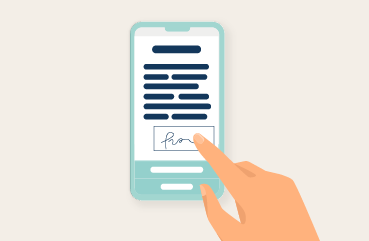
The digital signature is part of a modern authentication process that allows employers and employees to credibly sign employment contracts or any other documents requiring a signature, even without being physically present.
We currently see 5 main areas where the demand for digital signatures is huge.
1. Signing and amending employment contracts
An employment contract must be certified by signature in at least two copies by both the employer and the employee. This has to be done upon joining and whenever the contract is amended. In practice, contracts may be amended as often as every year, and every single employee has to sign the amendment.
In practice, the process looks like this: the contracts are generated for everyone, printed in the required number of copies and prepared for the employees to sign. Once prepared, the notification of employees begins, mostly through team or shift leaders. Following the notification, employees have to come in to the office or HR department, where the printed amendments are signed with each person one by one. This is when the problems tend to appear. Some colleagues may be on annual or sick leave, or on the road due to their job, right when they are supposed to sign the contract. It's also not uncommon for someone to sign incorrectly, in the wrong place, or accidentally on a colleague's copy — in which case the document has to be reprinted and the signing repeated. Depending on headcount and the issues that come up, running a process like this can take up to 2 months. All of this means a great deal of stress and work for the HR department.
With electronic signature, it takes 10 seconds per person.
2. Declarations
In certain cases, employees are required to make declarations. Typical examples are declarations about leave and family tax allowances, which must always be signed in a legally credible way.
In the case of the family tax allowance, employees must make a declaration every year about their children and the family tax allowance.
3. Policies and policy changes
Workplaces may have various mandatory and internal policies that employees must familiarize themselves with and confirm this fact with their signature.
These policies change frequently over a company's life, so their content often needs to be reviewed and certified by signature. Under the traditional procedure, these policies are printed and their content is delivered to every colleague. Sometimes this is done through workshops and small-group briefings, at the end of which every participant signs a document confirming they have familiarized themselves with the new policies. This process, however, is extremely time-consuming.
4. Training participation
For internal company trainings, employees must confirm their attendance or the fact that they have completed the training. In practice, this is done by signing the training attendance sheet, and in the case of successful completion or participation, sometimes an additional document.
For trainings held for managers, an added challenge is that the sessions are run by external trainers. Although they receive the training attendance document at the start of the session, it can get lost, or someone may not sign it at all or sign it incorrectly. The administrator then has to contact both the trainer and the employee, which can be extremely burdensome and time-consuming. Not to mention the room for error — the external trainer doesn't know the managers, so they may not remember correctly who showed up and who didn't.
5. Workwear and work equipment
At large companies, the handover of workwear and work equipment often has to be confirmed by signature as well. While this isn't necessarily mandatory, in the case of a high-value laptop or company car it clearly creates a transparent situation. For protective equipment it can even be a mandatory element if the role requires it.
It also happens frequently that when an employee leaves, a piece of equipment or workwear stays with them (e.g. phone, laptop, boots, etc.) but there is no certified handover record, because someone forgot to have it signed or the paper disappeared because it was never filed. This causes serious problems at companies where inventory must be taken and the available stock doesn't match the data on the handover sheets.
Why is it good for the company?
- It makes managing signature-required documents transparent. - We often don't know which documents have been signed and who we still need signatures from.
- It saves time and energy, not to mention that it reduces the room for error. E.g.: fewer copies printed, the employee signed incorrectly, the signature isn't legible, etc. Every mistake means starting the signing process over.
- From a data protection perspective it's also a far better solution than traditional spreadsheet and paper-based administration, where data is scattered around. Here, everything can be stored securely in a single central system.
- The document signature has a digital footprint, which is harder to forge than a signature and date made on paper, making it more reliable.
- It's an environmentally friendly, paperless solution that doesn't require maintaining an archive room of several square meters for storage.
Why is it good for employees?
- It's a convenient solution — a smartphone is all it takes to credibly sign contract amendments and other documents requiring a signature.
- The document signature has a digital footprint. It can be precisely traced what the employee signed and when, and whether it was truly them who signed it.
- Signing documents doesn't require personal presence, and there's no hassle with postal mail either.
- You can already pay with your phone in stores, so it will soon be completely normal for our smartphones to hold our digital identity along with our documents — letting us sign documents easily, securely and credibly, not only within the company but outside it as well.