
The advantages and disadvantages of communication AI
Published
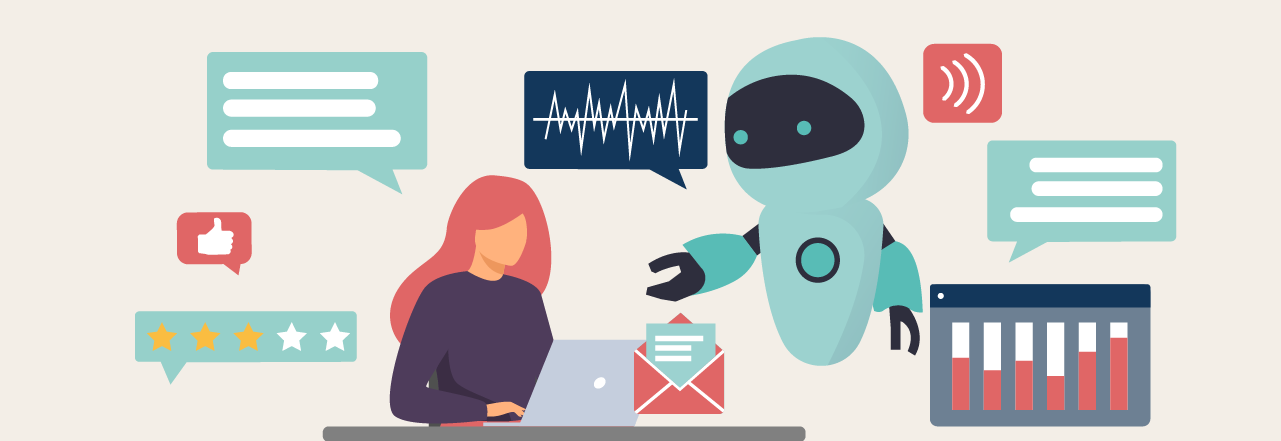
Although artificial intelligence has been with us for years, it's only in recent months that it has seeped into our everyday lives. It's used in more and more areas, so naturally it's now present in communication too. But what are the advantages and disadvantages of using communication AI?
What exactly is communication AI?
Artificial intelligence is a distinct field of computer science that attempts to create a system similar to human intelligence and problem-solving ability. The AIs that are created specialise in different areas. The artificial intelligence used in industrial machines, for example, won't be able to perform the tasks of a communication AI, and vice versa. While the former has, say, been taught how to cut out a car chassis part, a communication AI is an artificial intelligence whose job is to support communication.
Types of communication AI
For the sake of simplicity, I'll group the artificial intelligences whose role is to support human discourse into two broad categories.
1. Speech-based
These perform tasks based on human speech. A request/command is spoken aloud, and the artificial intelligence tries to carry it out. The three best-known communication AIs of this kind are Siri, Alexa and Cortana.
There are also speech-based communication AIs that convert speech into written text, or analyse what was said in order to determine the speaker's emotional state. By that I mean whether the speaker is angry or calm, for example.
2. Text-based
I think that, based on the brief overview above, you've already worked out some of the advantages yourself. It's also quite possible you already have your own experience of using one communication AI or another. Even so, I'd like to spell out a few advantages. In presenting them, I'll start from the assumption that you are
- a busy company leader (at whatever level)
- an HR staff member responsible for internal company communication
1. Boosting efficiency
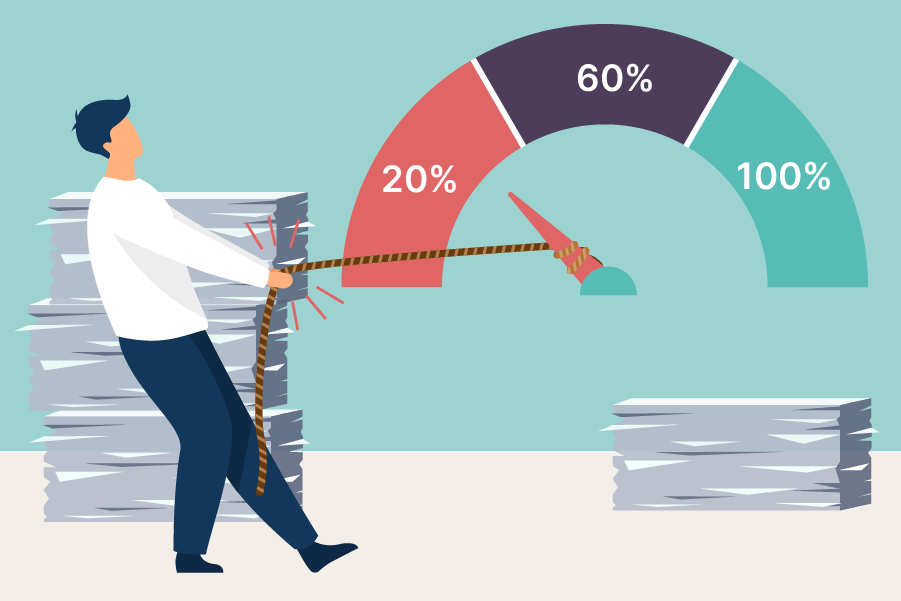
The biggest advantage of communication AI is that it speeds up workflows. This can happen on several levels.
1.1. Fast copywriting
Even the most talented communicators sometimes run out of ideas and struggle to put their thoughts into words. At times like these, instead of hours of agonising, it's worth turning to a text-generating artificial intelligence. You describe roughly what you need and ask for 10–20 text suggestions, which the communication AI generates in seconds. Then you pick the most suitable one. Of course, that probably won't be perfect either, but you can tweak it in minutes to get it right. Or if none of the suggestions really appeals to you, you'll almost certainly have picked up a few ideas along the way that you can do something with.
So instead of hours of work, a few minutes are enough to write company announcements, greetings or other messages.
1.2. Communication without borders
It's increasingly common for people who speak different languages and have no common language to work together. This is especially true at companies that mainly employ blue-collar workers. A factory worker doesn't necessarily speak a foreign language fluently, which makes communication significantly harder. The foreign employee can only handle HR administrative matters with the help of an interpreter, and company management can also only get information to the employee through an interpreter. This, however, considerably slows down workflows. Some communication AIs are meant to fill this gap.
In the CHEQ internal communication tool, for example, it's enough to write your messages in a single language, which the system translates with one tap into every language you ask for. As a result, the Ukrainian employee will read the message in Ukrainian, the Mongolian in Mongolian, the Vietnamese in Vietnamese and, of course, the Hungarian in Hungarian. The reverse is also true. If the Vietnamese employee sends a message on the CHEQ interface, the recipient will receive it in their own language.
Communication AI therefore makes it possible to reach colleagues who speak a foreign language within minutes instead of days or weeks.
1.3. Automation
Let's be honest: unless it's our adorable little child asking the same thing a hundred times, no one likes repeating an answer more than three times. So why would we expect HR staff to spend a significant part of their time answering frequently repeated questions? With communication AI, this can be automated. You only need to write the answer to the question once, and you can leave the rest to the artificial intelligence. Whenever a common question comes in from one of your colleagues, they can get an immediate answer from the AI, which is good for everyone. The HR staff member doesn't have to write out the answer 1,527 times and doesn't have to interrupt their work to respond. And the employee asking doesn't have to sit on pins and needles waiting for a precise answer to their question. What's more, through CHEQ they can ask whenever the question arises, instead of waiting for a designated time to ask.
2. 24/7 availability
I've alluded to this before, but it's worth noting separately that communication AI is always available. It doesn't matter whether it's night-time, the weekend or a public holiday. It's always on hand and helps with whatever it can.
3. Personalised communication
With the help of artificial intelligence you can send personalised messages to your colleagues. This is extremely important when you don't want to share a general company announcement that really concerns everyone.
Employees' interests and information needs can vary. Male employees probably aren't interested in the administrative process you have to go through to return to active duty from maternity leave. And likewise, colleagues working in the warehouse may not be interested in an innovation affecting those on the production line.
Using communication AI makes it possible for colleagues to be informed only about what they want to know and what concerns them. In the CHEQ AI-powered communication tool you can also set what each colleague is notified about. The advantage of this is that everyone concerned will read the messages they receive, because they know it's something that interests them. And you, as the sender of the message, don't have to keep ticking off one by one who should be informed about what. It's enough to select the group to be notified.
The disadvantages of communication AI
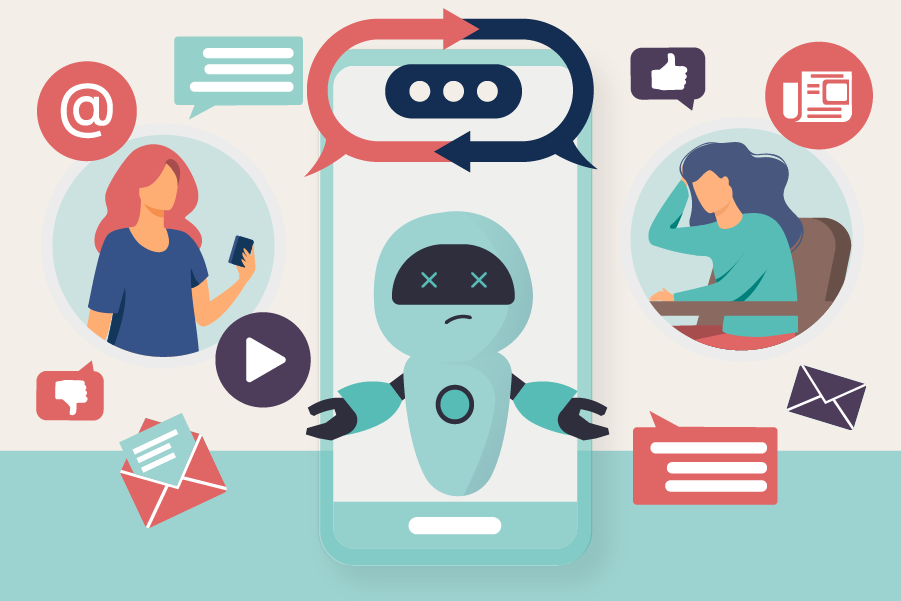
Although communication AI has plenty of advantages, we mustn't forget the disadvantages either, so that you can form a more realistic and complete picture of it. I'd add that I prefer to think of these disadvantages as the kind of advantages that will guarantee human work for a long time to come.
1. Communication errors
It's still common for artificial intelligences to misunderstand people's communication or to phrase things incorrectly. Here I'm thinking primarily of communication AI that is less controlled. ChatGPT, for example, freely formulates answers to the questions put to it. By contrast, through the CHEQ communication channel only the automated answers that you and/or your colleagues have previously approved are sent out. In other words, although communication AI significantly speeds up work, for now it still can't work reliably without human input.
2. Lack of empathy
Artificial intelligence lacks human emotions. Although some AIs are able to recognise human feelings such as anger, most of them are currently still unable to handle complex emotional problems. Their responses can be cold, which isn't very helpful when an employee is going through a tougher period.
3. Lack of creativity
Communication AI is very good at creating the impression that it's capable of creativity. But that isn't true. Creativity remains a human privilege. Artificial intelligence is incapable of creating something new out of nothing. It can only produce anything from what it was previously taught.
Conclusion
Communication AI is a tool that every company would do well to use. It speeds up workflows and takes the load off employees handling communication tasks. Their current level of development makes them excellent assistants, but they don't replace human resources. That's exactly why no one needs to fear them. On the contrary, it's worth thinking about how and in what form to introduce it at your company in order to make your internal communication more effective. On that note, I'd draw your attention to CHEQ's solution. Request a FREE demo!