
The role of digital transformation in boosting business performance
Published
Digital transformation is more than just a new trend. It is an indispensable activity and an important element of corporate strategy that significantly influences work productivity and results. Digital innovation is playing an increasingly large role when it comes to boosting competitiveness and efficiency. However, the companies of Central and Eastern Europe are lagging behind Western companies in terms of digitalisation and productivity. We help bridge this gap with the CHEQ app.
The impact of corporate innovation and digitalisation on productivity
More and more European companies are recognising the opportunities inherent in digital innovation, which contribute to increasing market competitiveness. That is precisely why they are starting to apply these solutions ever more actively in their workflows, thereby also increasing productivity.
However, there are significant differences between the digital infrastructure and digital skills of the individual European countries. Hungary, for example, is significantly behind the EU average. The efficiency of digitalisation in Hungary is only 63% of the EU average. And if we look at the average of the EU's top five countries, we reach a mere 48%.
This is why applying technological innovation matters
Introducing innovative digital technologies can bring significant improvements in productivity and efficiency. This is supported by research conducted by Deloitte, according to which highly digitalised companies are 3x more likely to achieve annual revenue growth than those where the level of digitalisation is low. Of course, it must be noted that this is only true if employees are actually able to use the digital tools. Otherwise, digitalisation is pointless and can even be counterproductive.
At the same time, digital transformation also supports companies' ability to react quickly and adapt, with which they are able to respond appropriately within a short time to challenges arising from changes in the economic environment. This also provides them with a kind of flexibility and further increases their competitive advantage.
The challenges of digital transformation
Corporate innovation and digital transformation come with numerous challenges, which can be extremely varied. Perhaps the most critical of these is the effective integration of digital tools into business processes and into the corporate culture. This often also requires building a new technological infrastructure, but the tasks arising from the specific characteristics of human resources must not be forgotten either. What exactly do these challenges consist of?
1. Technological infrastructure
It often happens that companies work with outdated systems and machines that they do not want to scrap because they still have book value. They therefore look for new technological solutions that are compatible with their old systems. This, however, is not always a viable path and can come with a great many software problems, which also carry business risk. On top of this, the user experience decreases on the employees' side. As a result, they form a negative opinion of every digital innovation.
2. Corporate culture
Digital innovation and corporate culture interact with each other. Digitalisation also changes working methods and internal communication. Many people, however, find it hard to accept such changes. That is why it is so important for management to support the digital transformation 100%, both by continuously ensuring the (re)training of employees, and by switching to using digital methods themselves.
3. Designing processes
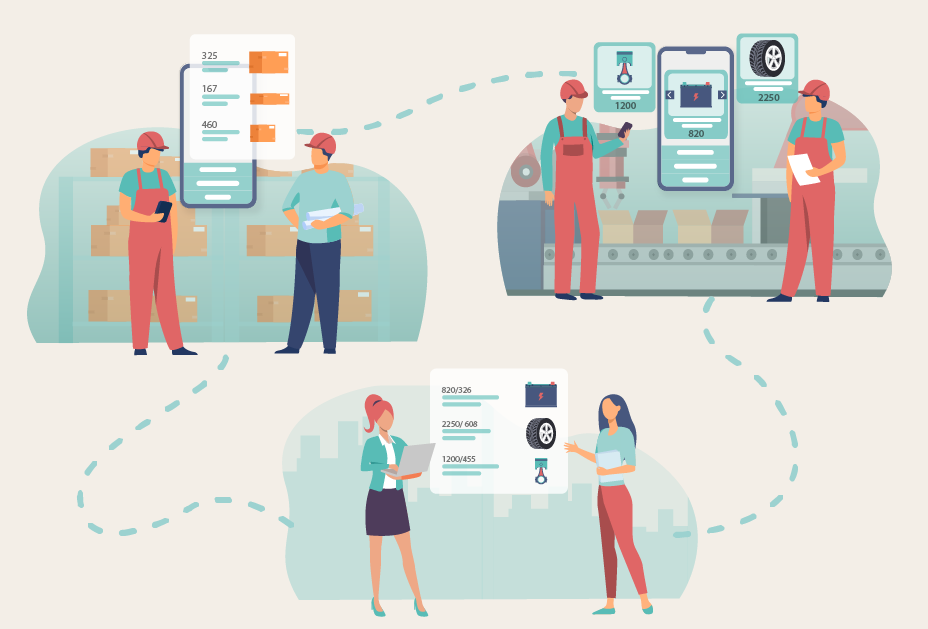
We could even consider this the zeroth step, that is how important it is. Because we never digitalise the company itself, but rather the processes. So first we have to map out what internal processes we have in the individual operational areas and how they connect to one another, that is, where the so-called connection points are. This is an essential precondition for the effective creation of full automation, which at the same time also ensures that every organisational unit of the company takes steps in line with the current expectations and conditions. As a result, work becomes more efficient and productivity increases too.
4. Human factors
A company is only as digital and innovative as its employees are. Within the entire employee base, this is the most pressing question. It is typically an interesting question for blue-collar workers, who represent the largest proportion,
- who typically have no access to the corporate IT systems,
- for whom using them is too complicated,
- who are not, or only to a limited extent, reachable by email, and
- for whom training generally needs to be provided in a different form suited to this target group.
If the employees working in production still record and receive everything on paper, and HR and managers also communicate with them this way (e.g. noticeboard, information leaflets), then the company is not a leader in the field of digital innovation even if the office workers use the latest cutting-edge technologies.
Training and developing people is crucial.
If, however, in the case of blue-collar workers the company cannot spend money and time on this in its traditional form (e.g. classroom training), or does not have enough personnel resources for it, then one solution can be to choose a user-friendly digital solution for this purpose, such as CHEQ. Using the tool is extremely intuitive and so simple that even a 6-year-old child could use it.
5. Financial constraints
Another obstacle tends to be that most companies want to introduce digital technology fit for a moon landing while being willing/able to pay only for a drone, all the while stubbornly clinging to the results plan expected from digitalisation. And they are very surprised when they are confronted with the sad situation that the drone-like digital solution does not deliver the performance they imagined. The problem is compounded by the fact that they want a solution they can use for decades to come. However, one has to accept that digital innovation thinks in shorter time frames than this, since new and revolutionary technological solutions are born day after day.
Note
At CHEQ we know that for many companies, introducing a digital tool at company level represents a financial difficulty. That is precisely why we make it possible to start the transformation with just a few basic features. Later on, you can expand at any time with the 50+ available use cases. What is more, thanks to continuous development based on market needs and technological changes, the tool is always up to date, so even years from now it will be able to flexibly serve current needs.
6. Resources
The process of digitalisation has to be worked on, and this often - like most developments - means extra work at first for the colleagues involved in the implementation project. This is frequently the reason why the digital transition progresses very slowly, or does not even begin. Managers deal with this temporary burden by deciding that digitalisation can wait, because there are more important, typically short-term, tasks to attend to right now, sometimes in firefighting mode. They think less about the fact that although digitalisation temporarily means extra work, once it has been introduced everything becomes much smoother, work becomes more efficient and performance increases too. That is also why it is important that, whichever organisational unit the digitalisation development affects, the decision about it should definitely be made at strategic level, together with the appropriate return-on-investment calculation and precise result expectations. That is exactly why most companies have a digital strategy.
CHEQ: the engine of corporate productivity
CHEQ offers companies innovative digital solutions that help optimise and automate certain routine tasks. It also supports more efficient human resource management and ensures that every employee, including the blue-collar workforce, can find out about the company's strategy and the objectives important to them, even instantly and from an authentic source. With the solutions CHEQ offers, management gets a tool in hand with which it will have the opportunity to align the company's operations even more efficiently, thereby supporting the achievement of strategic goals, the optimisation of processes and the increase of productivity.
On top of all this, it is also worth mentioning that with CHEQ we can take a significant step forward in sustainability and green solutions too.
The paperless office and ecological sustainability
Alongside the use of CHEQ, a paperless office environment can become reality. Numerous administrative tasks can be replaced with it, such as:
- signing and managing work-related documents (e.g. attendance sheet)
- signing documents related to employment (e.g. amendment of the employment contract)
- signing declarations related to benefits (e.g. cafeteria)
- documents related to data protection (e.g. GDPR)
- printing and distributing payslips, etc.
This is important not only for cutting office costs, but also because it makes managing and storing documents simpler and faster, with significantly less work. What is more, it also reduces the risk of administrative errors.
Beyond this, we must not forget that through paperless administration companies can also reduce their ecological footprint, which contributes to sustainability.
Digital transformation and workforce alignment
By introducing CHEQ, a company-wide digital transformation can be achieved that truly makes every employee reachable and involvable. After all, all you need to use it is a smartphone. And nowadays almost every adult has one. With the help of CHEQ, blue-collar workers, who have so far been left out of digitalisation programmes, can finally also get an accurate picture of the company's goals and of how they can be part of achieving results.
If you would like to find out more about CHEQ, then request a free and personalised demo.