
Digital onboarding and recurring training
Published

Most companies provide new employees with some guided training only during the onboarding of new hires. However, once the probationary period ends - on average this is 3 months - the training of employees ceases. Or at the very least, no emphasis is placed on it. As a result, it may happen that over time the quality of work deteriorates, that tasks are carried out more slowly, and that errors or workplace accidents multiply. This is precisely why it is extremely important that, alongside digital onboarding wherever possible, recurring training also receives attention.
Why are employees not trained?
Companies that do not place emphasis on recurring training for their staff usually justify their decision with the following reasons:
1. Providing training is costly
According to an old mindset, staff training can mostly be handled with training sessions. Organising a single training session, however, can come with enormous costs. The company has to pay the training fee, possibly rent a venue, and take care of the food and drink consumed during the training. Not to mention that the training has to be organised on a working day, which means the company may have to halt production and all work for as much as an entire day. This represents an indirect cost for companies, which is why they hold back from organising training sessions.
2. They cannot, or only with difficulty can, measure the results
This is mostly true of companies that predominantly employ blue-collar workers. In their case, assessing knowledge is quite difficult. They often do not have a company device through which they could take tests or provide confirmation regarding the training. In their case, the assessment either still takes place on paper, or on a designated plant/company computer that every colleague can use. Whichever outdated method a company uses to assess blue-collar workers' knowledge after a training session, the results will most likely be inaccurate.
3. They find it useless
Even when the invited trainer possesses immeasurable professional knowledge and experience, there is no guarantee that the training will be effective. In this case too it may happen that the trainer is simply unable to convey their knowledge in a form that is immediately usable for employees. But even if they do manage to achieve this, the question still arises: for how long will employees be able to put the knowledge gained during the training to use? It may be that after 1 week or 1 month employees again do everything the way they did before the training. So what is the point of organising training sessions? 8% of companies are afraid that the training will ultimately prove ineffective. That is why they choose not to organise any at all.
4. "If I train them, they leave"
Some companies are afraid that if they provide training opportunities for their employees, those employees will put the knowledge gained there to use elsewhere. That they will change jobs before the financial resources invested in their training pay off for the company. Of course, this cannot be ruled out 100%, not even by drawing up a study contract, but according to research, employees are happy to stay, and stay longer, at companies that devote attention to training. This, after all, represents an opportunity for a career within the company, and is a clear sign that retaining the workforce matters to the company.
Think of your employees, and choose digital training
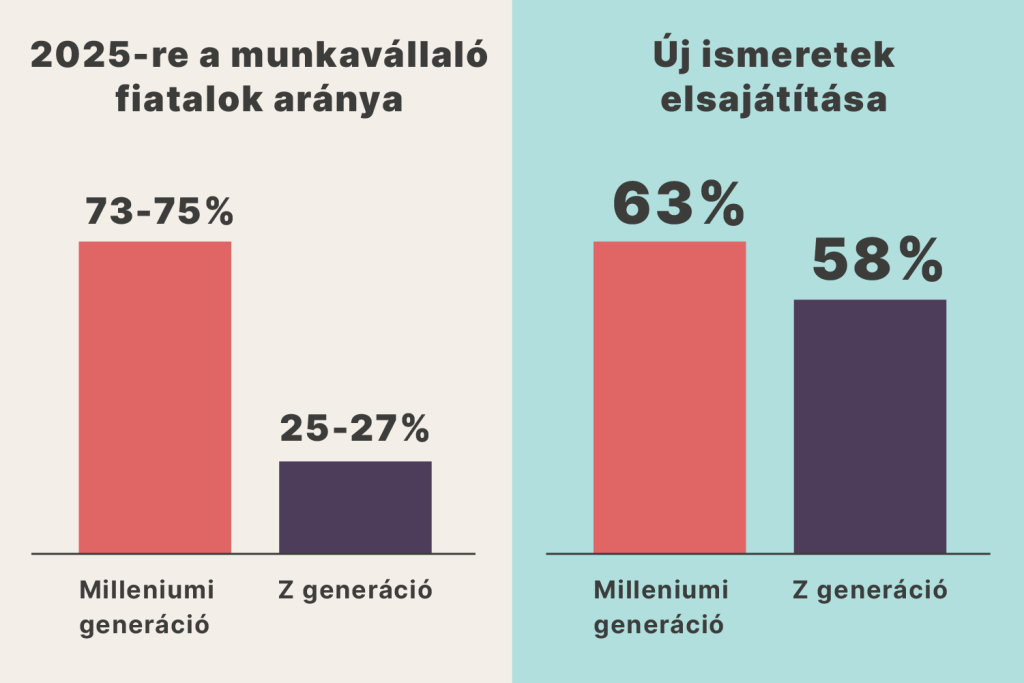
According to some forecasts, by 2025 close to 73-75% of employees will be Millennials and 25-27% will be Generation Z young people. This also means that the labour market is being transformed. Whereas for members of the Baby Boomer and Generation X, workplace stability was important, for the new generation self-fulfilment and self-education come into focus. According to a survey, 63% of Millennials and 58% of Generation Z would like to acquire new knowledge. However, the form in which they can access that knowledge is by no means unimportant to them.
The new workforce prefers digital training over traditional training sessions. This is especially true of Generation Z, who were already born into the world of the internet and smartphones. For them it is almost completely natural that, with the help of their smartphone, they can look up answers and solutions at any time, or communicate with the world through it. Including with their employer, then. This is precisely why it is recommended that companies set up a platform suitable for digital training as soon as possible. After all, in the future this can increase the employee-retention rate. Otherwise, good workers may resign before the company even has to worry about whether the amount invested in the employee's training will pay off.
Why choose digital training?
Digital training, and microlearning in particular,
- is cost-effective,
- can be produced quickly,
- is accessible at any time
- is easy and precise to measure
- supports the deepening of knowledge
- contributes to knowledge retention (we remember the training material longer)
In other words, through digital training we can effectively handle almost every one of the problems mentioned above that cause companies to hold back from training employees.
On top of that, if you set up your digital training through CHEQ, then access becomes extremely simple for employees. The CHEQ chatbot-based application can be used on a smartphone, even through Viber. This way employees do not actually have to acquire any new technological skills in order to use the knowledge base. In addition, no company email address is required to access the application. With CHEQ, employees can look up the information they need at any time. It is as if they had a pocket guide in their pocket that can even show them how to safely replace a gas meter, should that be their task.
Why is it advantageous to use a digital solution as early as the pre- and onboarding stage?
One reason why it is worth carrying out pre- and onboarding digitally as well almost speaks for itself. As more and more Generation Z young people enter the labour market, the demand for using modern technological solutions grows. Paper-based methods of onboarding staff, left over from the last century, are already outdated. On top of that, in many cases it is not even clearly communicated to new employees in which document they can find the data important to their work, where they should look for it, or whom they should ask. This can lead to a poor workplace experience, which may even end in an early resignation. According to research, 21-24% of new employees are lost during the probationary period.
Digital pre- and onboarding, however, allows new employees to access all the knowledge the company uploads to the digital platform easily, with just the press of a few buttons. And if the company uses CHEQ to digitalise onboarding, then the employee also gets their own digital assistant whom they can ask anything, including
- what is the weekly menu in the company canteen?
- when does the company bus leave?
- who works at the company?
- what fringe benefits can they claim?
- what products/services does the company have?
- what is the work standard?
- how should work machines be operated correctly and how should workplace tasks be carried out?
- how should products be manufactured/prepared according to specification?
- what is the expected conduct and protocol when providing services? etc.
The digital assistant never refuses to help, citing a lack of time out of fear that the new employee might oust them from their position. And it never gives, whether intentionally or not, incomplete or incorrect answers to questions. This way the onboarding of new employees can be kept at a high standard, and it can even be standardised by work activity.
The other reason why it is recommended to handle onboarding digitally as well
As a result of this, every new hire gets used to this form of training and internal communication. This way digital microlearning becomes completely natural for them when recurring training later takes place in this form too. Or when they complete the annual mandatory training sessions and tests, such as occupational and fire safety training, here.
If you make digital training available to employees through CHEQ, or through another similar application, then this positively influences the ROI (return on investment) associated with introducing the system too. Employees who subscribed because of the digital training get to know the application, and sooner or later they will use the CHEQ self-service channel to handle their administrative matters as well.
This is especially true if, within a microlearning session, you also show/teach your colleagues what CHEQ can be used for and how. A general chatbot training and test like this can be found among CHEQ's basic features from the very moment you start. So with this you essentially have nothing else to do but watch how many of your colleagues complete the microlearning.
Find out how you can use CHEQ for digital onboarding and other recurring training! If you are interested in the details, then request our free demo.