
Scheduled communication is a super tool
Published

Most people like to make their own work and life easier. That is exactly why every technical solution that lets us automate and schedule tasks is so popular. No wonder, then, that scheduled communication is by now almost a basic requirement for every corporate internal communication application, including CHEQ. But what makes it such a super tool in users' hands? That is the question we explore in this article.
What does scheduled communication mean?
Although the name speaks for itself, I still think it is worth describing briefly. The essence of scheduled communication is that a given message (written, image, voice or video) goes out to the recipient(s) exactly when we want it to. We can tie this to a specific point in time, e.g. the message should go out on 26 February 2023 at 10:32. In this case, the message goes out at this time and only at this time. In addition, we can also tie the sending of a scheduled message to the moment of an action. This is the kind of scheduling we talk about when, for example, we send out a message welcoming a new employee who has just joined the company. Everyone receives this message once — at the moment they join the company.
The benefits of scheduled communication
Let me highlight three benefits of scheduling for you.
- You can work ahead. So when you go on holiday, you don't have to worry about who will write and send out the message to your colleagues in your place.
- You don't have to keep recording the same message over and over again — doing it once is enough. With scheduling, you can automate the sending of certain messages.
- You are in control. You decide which messages go out, when, and to whom.
What can this feature be used for?
Since I mentioned new employees earlier, let's circle back to them. Through them, the use cases of scheduled communication can be demonstrated remarkably simply.
It is probably nothing new that, ideally, a company prepares for welcoming new employees with an onboarding plan. Part of this is the fire safety and occupational safety course, along with other training materials about the company's products or services. Of course, there is plenty of other training content you can share with both new and long-standing colleagues. Thanks to scheduled communication, it is enough to write the message drawing a colleague's attention to a given training material once. From then on, the message goes out whenever you want it to.
You can also schedule tests. Once a training module has been completed, you can decide whether the message asking the employee(s) to fill in the test should go out immediately or after a day or two.
You can reduce missed deadlines, since scheduled communication also lets you send reminders to your colleagues. For example, two weeks before a project deadline you can call their attention to the approaching due date. You can do it again one week or a few days before the deadline. No one will fall behind on a task again just because they forgot about the deadline.
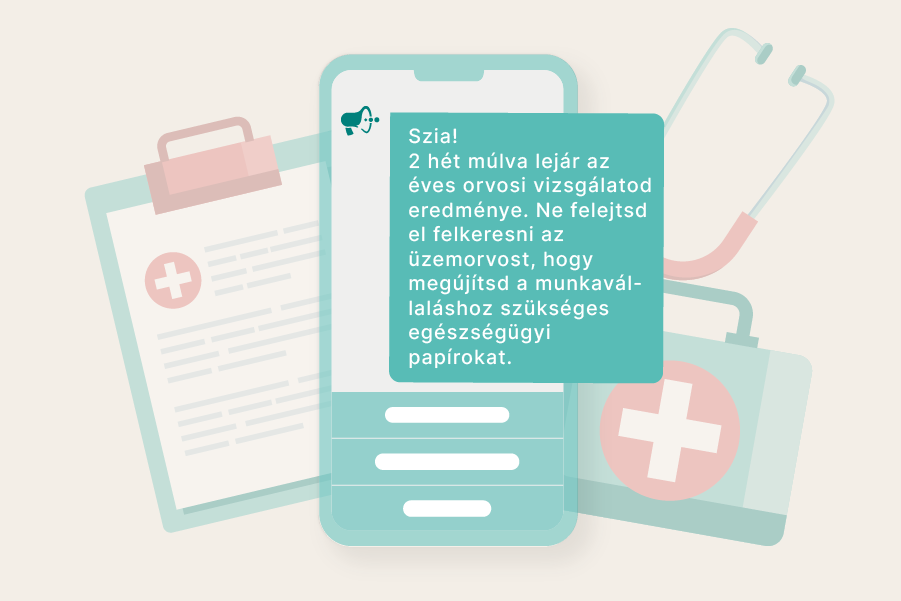
Before medical check-ups and/or licence expiries, you can also send scheduled messages to employees to ensure smooth and continuous work. When a new employee joins, you can set up a scheduled notification for the tasks that concern them right away.
Ultimately, we can say that scheduled communication ensures more plannable, continuous communication between the company and its employees. At the same time, it contributes to uninterrupted work and even increases efficiency.