
Onboarding checklist for blue-collar employees
Published

Many companies believe that once an employee has accepted their job offer, there is nothing left to do but prepare the employment contract and wait for the first day of work. After all, out of all the applicants they picked the person who is professionally right for the job. So they often expect the employee to know everything the role requires and to find their way around the new workplace on their own. Yet no matter how much professional experience an employee has, a new place is always unknown territory. That is why new colleagues need support from the very first moment, so they can settle into the new work environment as soon as possible. But how exactly do we do that? The checklist below helps with the onboarding process of blue-collar employees.
This article comes with a FREE e-book that helps you design your onboarding process.
Click here to request the e-book!
Orientation is not onboarding
It happens very often that people think welcoming the new colleague and giving them an orientation on day one is onboarding. It is not! Of course, orientation is part of onboarding, but successful onboarding does not stop at:
- the receptionist or the HR colleague letting the new colleague into the work area,
- showing them where to find their work group,
- or where the restroom and the canteen are
Onboarding is a far more complex process that can last for months, during which we familiarise the new employee with:
- the company culture,
- the company's goals,
- their colleagues,
- the company's products/services
- their own tasks and the targets they need to reach, based on which their performance will be assessed
- the information, data and training materials needed for high-quality work
- the customary local practices
- preparing the team for the new colleague's arrival
Naturally, giving the colleague feedback and positive reinforcement is also part of onboarding. Praise good work openly and raise any problems or mistakes in private. All this gives the new employee such a pleasant experience that their performance increases and they gladly stay with the company for the long term. Good people are a treasure among blue-collar employees too! What's more, thanks to successful onboarding it is 3x more likely that the new employee will describe their new workplace as the best place they have ever worked. And this behaviour contributes greatly to raising the employer brand.
How does the onboarding of blue-collar employees usually happen?
It is sad that although onboarding is a familiar concept to many, they still fail to put it into practice properly. With white-collar colleagues it more or less works. With blue-collar colleagues, however, it often stops at the workplace orientation.
In most cases, the blue-collar colleague is contacted by phone about the start date and the documents they need to bring for registration. Then on the first day, in the better case, they are handed a small printed document pack containing the
- employment contract
- job description
- workplace rules
- work schedule
- attendance sheet
- work inspection checklist
- place of work
- contact details of their direct supervisor
- contact details of the occupational physician, etc.
Besides not being the most ideal solution from an environmental point of view, this has little practical benefit either. Moreover, it does nothing to encourage dialogue with the new employee or their integration into the company culture. This is perhaps somewhat offset by the fact that after finishing the administrative matters at HR, they are sent on to their immediate supervisor. The supervisor may show them around the workplace, introduce the colleagues and clarify the main tasks. After the first day, however, new blue-collar colleagues are often left to fend for themselves.
But let's take a closer look at what causes this phenomenon.

Problems with the onboarding of blue-collar colleagues
Sometimes even the best intentions are not enough to pull off the onboarding of blue-collar employees. Behind this, we mostly find the following causes and problems:
- lack of human resources — longer-serving employees cannot fit looking after a new colleague into their day
- the person appointed as mentor is unsuitable for the role (their knowledge has gaps, or they themselves only recently joined the company)
- colleagues work geographically scattered: keeping in touch and communicating is difficult
- there is no proper logical and technological foundation in place for it
How could the onboarding experience of blue-collar employees be improved?
Fair warning: you may not like what you are about to read. Because in order to make the onboarding of non-office colleagues simpler and the HR department's work more efficient, you will have to build a proper technological system within the company. The good news, however, is that on the one hand this speeds up and eases the work of HR staff — the onboarding process and its results become easy to track, measure and report on — and on the other hand it provides the basic framework on which a modern, environmentally conscious, 21st-century onboarding can be built.
I know, at first it may seem a waste of money and energy, but let me point out that it all pays off. Did you know that successfully onboarded employees stay with the company for up to 3 years and beyond? By not having to train up a new colleague every 3-6 months, the company not only saves on recruitment costs, but production and performance do not drop either. This way the losses caused by employee turnover can be avoided. On top of that, HR no longer has to constantly look for new staff, interview candidates and administer all the paperwork of joiners and leavers. Instead, they can focus on other, more creative and more useful tasks that recruitment would otherwise push into the background.
All right, let's assume you have the technology in place for better onboarding. This means you have moved everything you could onto digital tracks and automated it. Depending on the solution you chose (e-mail, intranet, public communication apps, or your own chatbot-based communication app, etc.), you can start planning the onboarding of your new blue-collar employee. Whichever solution you chose, you must definitely cover the following!
Onboarding checklist for blue-collar employees
- Let them know in advance how to prepare for the first day: what should they bring?
- Prepare their uniform/workwear, gown, apron or whatever the mandatory standard attire is at your company (check their clothing size beforehand).
- Make sure that every tool needed for the job is at their disposal
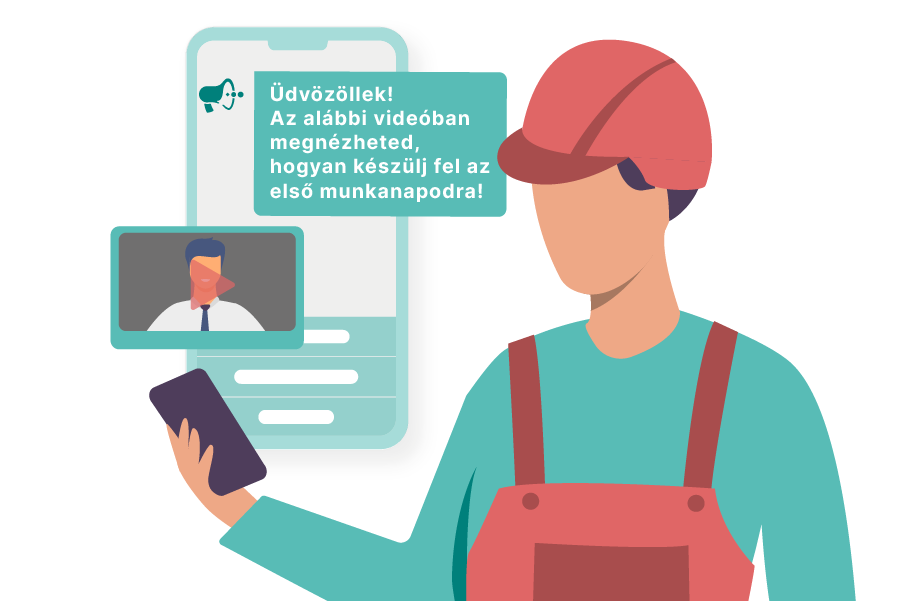
- Put together a welcome pack for them (it can be a welcome card or a short welcome video from the company's leader — obviously this video does not have to be recorded separately for every new joiner)
- Prepare training materials on the following and make sure they go through them with you or with one or two designated colleagues (ask for feedback / have them take a test):
- occupational safety rules and requirements
- internal workplace rules
- fault and accident reporting
- workplace conduct
- work schedule and breaks
- safety training — how to use their work tools safely
- Appoint a mentor who helps them settle into the new environment faster and who can also give the new colleague professional support.
- Set concrete goals and milestones. The new employee will know exactly what you expect from them during the probation period, and it will be easier for you to measure their performance.
- Every week or two, ask the new employee for feedback on how they are progressing with settling in and mastering the work processes, and what they find difficult. This way you will find out in time if they need support.
If you would like a more detailed, step-by-step, 21st-century checklist for the onboarding of blue-collar employees,
download the free e-book!