
Microlearning, for better-prepared employees
Published

Every company wants to employ well-trained staff. To achieve this, however, it is not enough to hire professionals who are currently qualified. It is also essential that we continuously provide for the further training of employees. The technology around us is constantly evolving, and the professional knowledge required to perform work to a high standard changes and expands as well. Microlearning helps employees keep pace with these changes without any particular effort.
So what exactly is microlearning?
Microlearning is the form of learning where we focus on solving a specific problem or answering a specific question. We can view this information anywhere and anytime. Often all you need for this is a smartphone, and there is no need to log in to a learning platform. Their huge advantage is that the training materials can usually be worked through in 2-5 minutes. This is important because, according to one study, most adults are on average only able to concentrate on a single task or activity for 15-20 minutes. After that, attention starts to wane and our thoughts wander. Of course, the ability to concentrate varies from person to person. What we can be sure of, however, is that a healthy adult is able to focus 100% on a task for 5 minutes. So through microlearning we really can develop our own abilities and those of our colleagues.
The positive effects of microlearning
1. It develops skills
Even 5 minutes of learning a day develops employees' skills as well as their professional knowledge. Well-trained employees are able to do the same job to a higher standard in less time, which less-trained colleagues do more slowly and less well. So we can say that microlearning can speed up work and reduce the number of workplace accidents and errors.
2. It contributes to knowledge retention
In professional training, continuity is more effective than intensive learning. The reason for this is that the knowledge acquired during intensive learning is superficial. We cannot concentrate long enough to fully take in the material to be processed during intensive training. And even what we do manage to remember only enters short-term memory. The German psychologist Hermann Ebbinghaus found that learners forget about 50% of what they have learned/heard on the same day, and 90% within a month. In other words, after a while we are unable to recall the information and put it to use.
By contrast, continuous learning contributes to deepening and expanding knowledge and supports its integration into long-term memory. This way the acquired knowledge can be recalled at any time later on.
As an interesting point, I would mention that Walmart reduced the number of workplace incidents by 54% after introducing microlearning, through which it managed to keep employees' knowledge fresh and to expand it.
3. It helps build workplace relationships
Thanks to microlearning, employees interact with the company, provided that the training takes place through a corporate platform, e.g. CHEQ. They can indicate on which topics they need knowledge support, what problems they are looking for solutions to, or what questions they would like answered. In addition, if several employees make use of the microlearning option, that can be an excellent topic for sparking conversations among colleagues.
4. It has employee-retention power
Employees stay longer at companies where there is an opportunity to learn through microlearning. The reason for this is that employees feel they are being looked after, that their training and professional development matter to the company. Employees often experience this as an opportunity for career building.
5. It increases performance
Employees with up-to-date knowledge carry out their tasks faster and more precisely. They can handle more work, and because there is no need for constant error correction, the company's performance can be increased too. It is definitely worth providing training opportunities for employees.

The advantages of microlearning
1. It can be produced quickly
Since it is short training material, it can be produced quickly regardless of the format in which it is shared.
2. Its production cost is low
Given that in microlearning the knowledge does not have to be uploaded to a learning platform, the production cost is also low. After all, there is no need to subscribe to a learning platform, and therefore no need to spend money on having the material created in a format supported by the learning platform.
3. It is reusable
The same information can be conveyed to employees in several formats. This way they can choose how they would like to acquire the knowledge. At the same time, by presenting the solution to the same problem in as many as three different ways, we can easily multiply the useful content available to employees.
4. It simplifies training sessions
Since the material used in microlearning can be produced easily and quickly, employee training sessions are also much simpler to organise. In addition, data and other information can be updated easily and rapidly. On top of that, from the employee's (learner's) side it is also much easier to work through micro learning materials. This makes training much more effective.
5. It can be personalised
Employees can learn at their own pace, and can pick up the micro-training material whenever they want, or whenever they need it in order to do their job right away. Employees themselves can determine which topics they cover and in what order they work through the materials within microlearning. They do not have to follow a fixed order in order to gain knowledge that is immediately usable and understandable.
6. It appeals to those who crave modern learning
According to a survey, 63% of Millennials and 58% of Generation Z would like to acquire new knowledge. However, they feel they do not have enough time for it, so they never even get started with training courses. Microlearning remedies this. After all, everyone has 2-5 minutes - while waiting for the bus, while commuting to work or home, while waiting for lunch. Beyond this, it should not be overlooked that these generations use their smartphones confidently and gladly to carry out various activities. So it is not alien to them to train themselves through this device either.
7. It gives instant feedback
If we close a microlearning session with a short quiz, we get instant feedback on how well the training material was absorbed. Not only the employee but also the employer receives feedback on this. And depending on the result, the material can even be retaken several times.
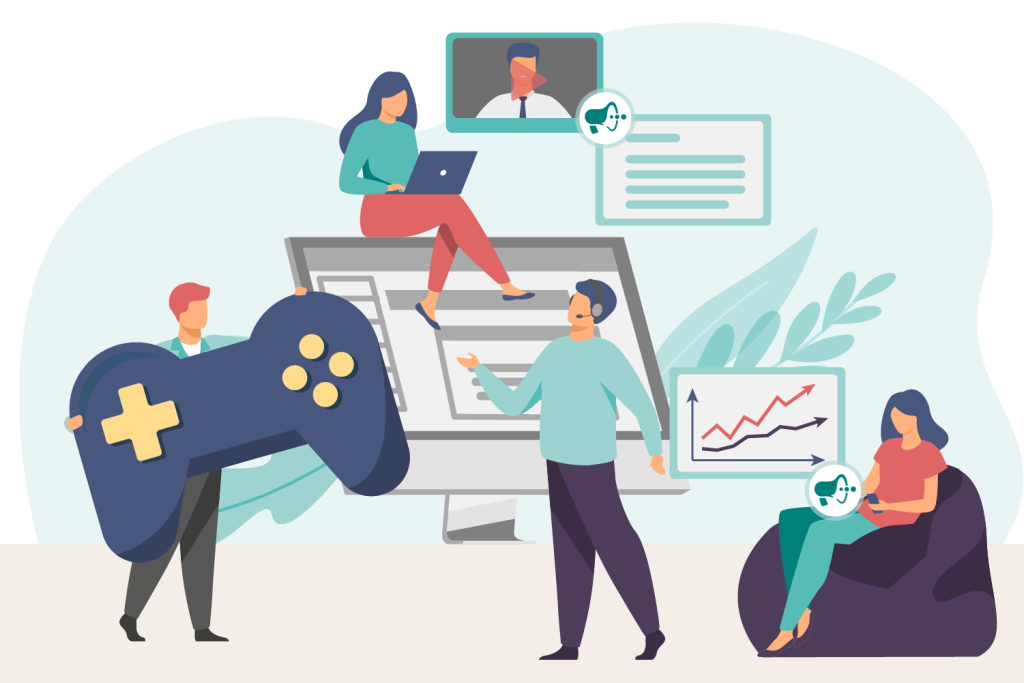
The forms of microlearning
1. Video
A great deal of information can be shared through animations. However, if we do not have a graphic designer colleague who can help with this, it is also an excellent option to record ourselves on video writing/drawing the training material on a board with narration. Or, for example, to make a recording of assembling an instrument, or of preparing the new menu, and so on.
2. Infographic
We can also use visual presentation to convey knowledge. Its advantage is that we see all the most important information in one place. An interactive infographic also helps deepen knowledge.
3. Webcast/Podcast
Microlearning through audio recording is a perfect choice if employees are frequently on the move or have vision problems.
4. Gamification
Gamification can easily be built into microlearning. This lets us make the transfer of knowledge more interesting, keep up employees' enthusiasm and attention, and get the most important information across to a larger audience.
How to introduce microlearning
As was mentioned earlier, introducing microlearning does not require you to subscribe to a learning platform that employees then log in to. However, if you want to measure its results, then you have to keep it within tighter bounds than simply uploading useful videos to YouTube.
When choosing the technical solution, you have to take into account that not all of your colleagues have a company email, or that they do not sit in front of a computer all the time to access the micro-training materials through it when they need them most. This is precisely why, if you want to ensure instant and easy access to the training materials, the most ideal thing is to make it available on the phone. After all, these days almost everyone has a smartphone.
CHEQ not only solves corporate internal communication without email, but is also an excellent platform for applying microlearning. It also provides the ability to track and measure. Through CHEQ you can measure precisely how many employees viewed each training material, and with what results they completed the associated quizzes. This way you can optimise the content of the training materials, break it down into levels, and there is even the option of gamification, which keeps motivation up. If you would like to learn more about how microlearning works within CHEQ, then read this article of ours or request our FREE demo.