
Buy a ready-made internal communication solution or build one?
Published

The question often comes up: which is better - for the company to buy a ready-made internal communication solution, or to develop its own software for this purpose? The question is mostly decided based on how much the ready-made solution costs and how well it covers the company's needs. However, you should know that it is worth examining more factors than this.
Steps and factors
In what follows, I will present the steps you need to go through and the factors you need to weigh when deciding whether to choose a ready-made internal communication solution or your own development.
1. Defining functions
As the very first step, you need to define what functions you will need. What tasks do you want to carry out with the help of the software? What requirements and challenges does it have to meet? What benefit does the communication software need to provide for employees to be willing to use it?
Everything needs to be thought through thoroughly, and an order of importance needs to be established.
Which are the functions that the software genuinely has to be able to do?
And which are the ones that would be nice if it could do, but are of no particular significance?
If you need a great many indispensable functions that cannot be found in any single ready-made internal communication solution, then your own development may come into question. Otherwise, it is worth trying out the ready-made solutions, since they are immediately available and have already proven themselves.
2. Control
From the point of view of company leaders and IT security, an important question can also be: who holds the control, and how much of it? You need to know that if you buy a ready-made software service, then the control will not be 100% with you. Not even if you operate the software solution from your own server.
Of course, you can approach full control, and the functions are modified and developed based on your feedback. However, exactly when and in what order these are realised does not depend on you. This is decided by the team supporting the ready-made internal communication solution, based on the feedback of the other clients. For them the most important thing is to be able to satisfy the needs of as many clients as possible. So they obviously focus on the solutions that affect more people, and not on that one specific situation that seems like an urgent development for your company.
There are leaders whom this puts off. They would like to have full control and full say in the development of the internal communication solution. In such cases, however, one has to consider whether the lack of full control is really a significant problem or not.
For example, for those working in national defence and national security this can be a burning issue. In the case of a factory making parts, however, it is unjustified. Especially because developing, operating and maintaining software that provides an internal communication solution is not the company's or the factory manager's field of expertise. Nor is it even that of the IT manager working at such a company! So they would not know what to do with full control anyway. Or, what is even worse, they would cause problems with incompetent management.
That is exactly why it is worth leaving full control in the hands of the experts and buying a ready-made solution that allows for customisation and close to 100% control. CHEQ is such a ready-made internal communication solution too, which makes it possible for you to assemble your internal communication software according to your own needs from 50+ functions.
3. Costs
Calculate and compare what costs are involved in buying a ready-made internal communication solution versus developing one. You can take both versions of development into account. Both the case where the colleagues working in the IT department develop it for you in-house, and the case where you commission a development team to create software specifically tailored to your needs, which they later hand over to you in full. It is important to note that the external team only continues to deal with the maintenance and development of the software afterwards if you give them a separate commission for it. This naturally entails a further cost.
For the sake of simplicity, from now on, when I talk about development, it will mean in-house development.
When calculating costs, companies often only reckon with the directly arising and foreseeable costs, such as the software production fee (providing tools, storage, etc.). The salaries of the developers working on the project, the extra costs stemming from experimental failures, or staff turnover are already taken into account less often. Few people take into account the losses stemming from tasks and projects that never got realised either. And yet, if we develop software that is not their field of expertise with our in-house IT colleagues, then it consumes their working time and their energy too. While they are developing the new internal communication solution, they cannot focus on essential tasks that would contribute to the company's profit.
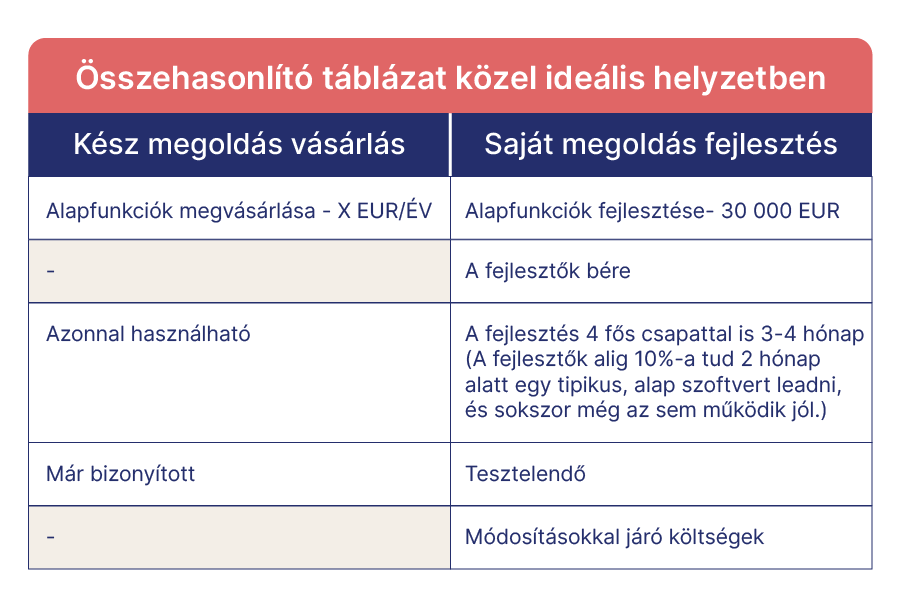
And we have not even talked about an unexpected situation such as having to replace a developer. In this case the project cannot progress, recruitment-related costs also arise, and the whole project may even become discardable. After all, if there is a personnel change in the development team, then the whole team can fall apart. Not all of them have an overview of the code and cannot simply maintain it. This slows down, or may even halt, the whole project. So the cost spent on development becomes wasted money, and on top of that the company still has no internal communication solution.
Alongside all of this, one should not forget about continuous maintenance and development either, which on an annual basis can mean costs on the order of 100 million forints. No company will pay this much for a relatively negligible internal project. However, companies that offer ready-made communication solutions as a service to other companies regard this cost as an investment that pays off. That is why they are willing to spend larger sums on continuous developments too, in order to provide an even higher-quality and more reliable service for their clients.
4. Questions regarding the internal communication solution
Before you cast your vote for development or for a ready-made internal communication solution, ask yourself these questions:
- Do you have a team that is capable of developing an internal communication solution?
- What happens if this development team breaks up?
- Who will have an overview of the project?
- Who can maintain the software?
- How long does developing the software take?
- What consequences does it have if you do not finish the project on time?
- How much more reliable will your own developed software be than an already tried and tested, ready-made internal communication solution?
- How much time will you need to teach employees to use the communication app?
- Which solution can you scale more easily?
- Who fixes the bugs and carries out the software updates/developments?
By answering the questions, you can see what arguments and counterarguments speak for one or the other communication solution. This helps you see clearly and make your decision calmly. It also emerges nicely from the answers that your own development requires enormous resources. Not only financial, but human resources too.
5. Assess the risks
Weigh up what risks are involved in using a ready-made internal communication solution, and what risks in your own development.
If you buy a ready-made solution, an important question for you may be whether the provider can handle the data in accordance with the regulations and securely. How likely is it that the data could leak and end up in unauthorised hands?
If, for example, you plan to send colleagues their payslips through this channel, then you need to know whether the system is able to encrypt the data and deliver it to the right people. This is a very important question, regardless of whether it is a ready-made solution or a self-developed app. After all, salary-related data is nobody else's business. That is why it was a cardinal question for CHEQ too to be able to send payslips and other important documents to the target people in encrypted form.
The fear of risks mostly stems from the lack of full control. Who takes responsibility for a possible data leak? Who can fix the bugs and how quickly? However, in such cases always remember that a company that offers a ready-made internal communication solution as a service can always handle such unexpected and unpleasant situations far more professionally than a company whose profile is something completely different. That is why you should always trust the experts!

6. Time and energy invested and return on value
When assessing the options, you will of course also take into account when you could start using the communication solution with employees, and when it is expected to pay off. The more urgent the introduction of an internal communication channel is, the more likely it is that you will choose the ready-made solution, since you do not have time to wait months for development.
Consider an unexpected machine stoppage, transport disruption, or IT outage. There is no time to wait months for a new system to be developed: every colleague must be reached immediately. That requires a working channel that also reaches frontline employees without company email or phones, including teams that speak different languages.
By choosing a ready-made internal communication solution like CHEQ, not only can you use the application almost immediately, but you will also see the results faster. Its return on investment (ROI) is easy to calculate and manage. In other words, by taking certain steps you can even speed it up. In contrast, during your own development numerous unforeseeable influencing factors can slow down the return. So much so that management may decide it is pointless to spend further time, money and energy on this project. Instead they close it and write it off as a loss.
7. Maintenance
Maintenance is nowhere near as simple a task as we laypeople tend to think. It also takes several days of work, and may require several developers. Especially when bugs pop up during maintenance, for example because of an update to some integrated software.
That is why, during decision-making, you should definitely ask yourself the question: if you vote for a self-developed solution, will there always be someone who can maintain the internal communication channel? What happens if the maintaining colleague goes on holiday? Will there be someone to cover for them? And if they unexpectedly resign, can someone take over their role immediately?
When buying a ready-made solution, you do not have to worry about this. There, the company providing the application is responsible for always ensuring high-quality and continuous maintenance for you, so that you can use every function of the communication channel smoothly.
8. Scalability
As employees, we tend to focus on the present and on solving the problems that currently exist. However, when it comes to whether to choose a ready-made internal communication solution or to have your own made, then the future has to be taken into account too. You also have to prepare for the fact that in the future other problems will have to be solved. Will the chosen application be capable of this? If so, within what time frame and at what price?
If you choose a self-developed solution, then it is essentially a function of your financial situation and human resources when and in what direction you extend the functions of your communication software. However, let us face it, most companies, even large enterprises, do not have such resources that they can scale their self-developed application within a short time. In contrast, if you choose a ready-made internal communication solution, then scalability is also easier to achieve. Take the CHEQ ready-made solution, for example, which currently has 50+ functions. If you activate 5 functions to start with, but later see that you would need further supplementary functions too, then you can easily add the chosen functions to the existing ones. You do not have to wait months for development and spend huge sums on it. Instead you can immediately enjoy the benefits of the functions.
Only develop if it gives you a competitive advantage
There is one more very important factor that you have to keep in mind before starting your own development. You have to think through whether the self-developed software provides you with such a great competitive advantage that it is really worth embarking on the project and taking on all the risks mentioned above with it. If it does not provide such a significant competitive advantage for you, then choose instead a ready-made internal communication solution that you can use immediately.
If you are interested in such a solution, then request a free CHEQ demo!